The AI Trust Problem: When Work Becomes Too Easy
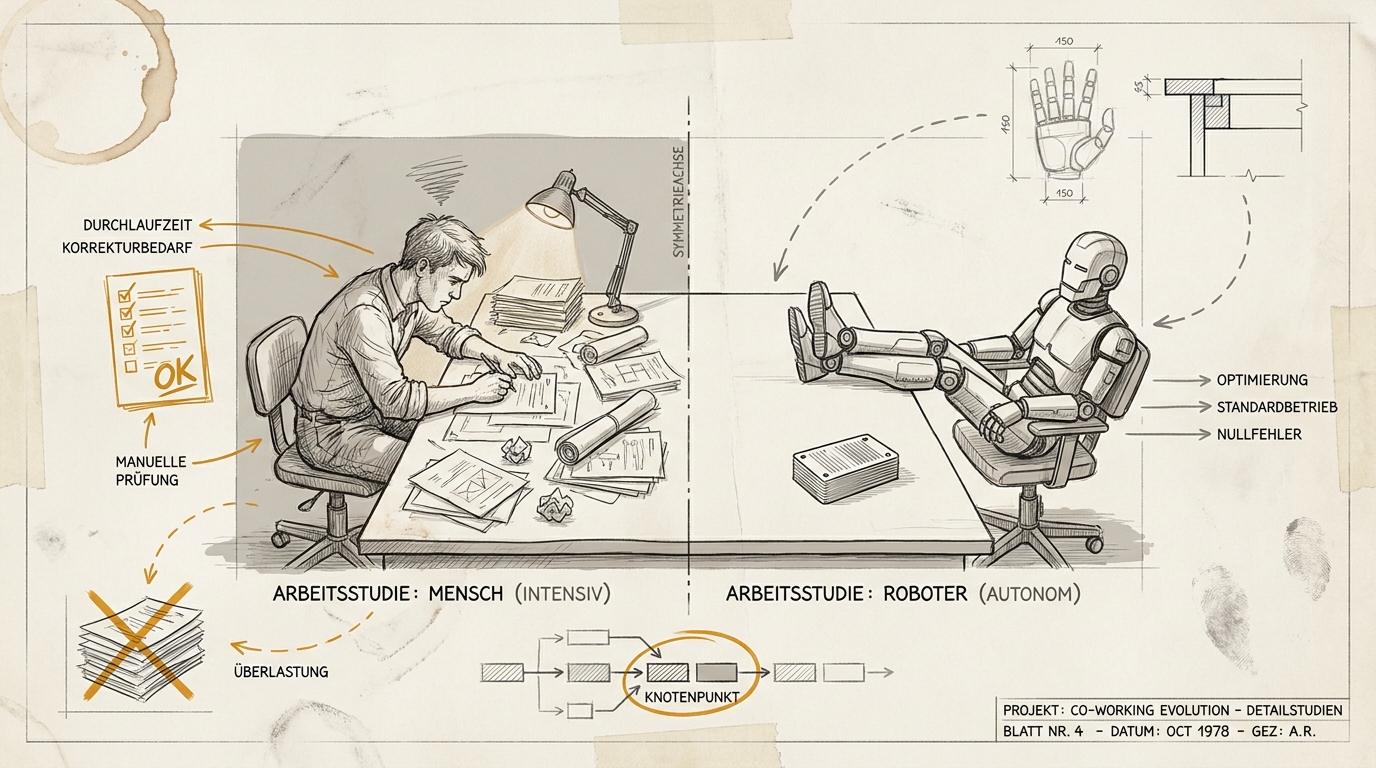
A strategy deck used to signal at least some amount of effort. Today it can also mean that someone ran a model and outsourced the checking to the client.
Practical test for this essay
Three templates for a conversation with an AI: clarify the goal, check contradictions, test whether the work can be delegated. You do not get a finished strategy or a tool recommendation.
Open the templatesA while ago, a small experiment made the rounds: a real Monet painting was presented as supposedly AI-generated. The reactions turned quickly. Bad composition. Generic look. AI slop.
The image was still a Monet. Only its assumed provenance had changed. And with it, the judgment.
That is what makes the case interesting. People do not only evaluate a result. They also evaluate the assumed effort, judgment and intention behind it. And in the case of a Monet, the assumed value of a work by Monet.
In a museum, or on Twitter, this is a neat little punchline. In your business, it gets uncomfortable quickly. And in the worst case: expensive.
Because the same question now shows up around every strategy deck, every client proposal, every market analysis: Did someone think this through, evaluate it, check it and take responsibility for it? Or did someone simply prompt an AI model?
For service providers, consultancies and agencies, that question becomes uncomfortable very quickly because it touches an old and mostly silent contract: the client never simply bought slides. Never only the result. What was also bought, and often especially bought, was the assumption that there was tested judgment behind those slides. And even that was often more appearance than reality.
Practical test: The three templates for this essay test whether a deck, concept, or proposal merely looks professional or is actually defensible. You do not get a slide writer, but a workslop check, a review trace audit, and a steering defense test.
Stay up to date
Get notified when I publish something new, and unsubscribe at any time.
The deck was never just the deck
A strategy deck is a strange product.
It looks like an artifact. 40 slides, clean layout, clear structure, charts, sources, recommendations. You can send it, present it, version it, archive it. In the end, a file remains.
But that file is never the only thing being paid for.
A client buys context and category understanding. Selection. Prioritization. Pushback. Industry feel. Political readability. The ability to turn too much material into a direction that can hold. And a piece of risk absorption: if I carry this recommendation into the organization, I am not completely on my own.
The deck is therefore not the actual value. It is the visible proof of thinking, expertise and responsibility.
Of course everyone knew, even before AI, that many slides were not personally built by the partner or senior strategist. Juniors research, structure, build tables, pull screenshots, write first text blocks and still format slides at night. That was never the secret.
The unspoken contract was different:
Cheap production work, but under expensive responsibility.
A partner, strategist, creative director or senior consultant had set the frame. Someone had checked the assumptions. Someone had decided what would not go into the deck. Someone would stand behind it if needed.
Whether this was always true is a different question. Many decks were also just nicely arranged and weakly evidenced assumptions. But the value of professional service still depended on this expectation: behind the artifact stands a system of experience, method and responsibility.
I genuinely think AI does not damage this "social contract" because it accelerates the actual production work. It damages it when the assumption of responsibility becomes invisible.
B2B breaks differently than B2C
In consumer contexts, the mechanism is easy to see. When an image, a text, a song or a gift looks like AI, perception often tilts. It feels less personal, less effortful, less real.
The B2C question is:
Was this really made for me?
In B2B, the issue is different. Nobody seriously asks whether a market analysis was made with love. This is not about romance. It is about defensibility.
The B2B question is:
Can I take this into a steering meeting without having it blow up in my face?
That sounds more rational. It only partly is. B2B is also full of signals, shortcuts and quiet perception logic. They just are not called authenticity. They are called due diligence, senior attention, track record, methodology, governance, quality assurance.
Those are not soft extras. They are trust signals under uncertainty.
Professional services are a special case here. Quality is hard to assess before purchase. Often it is not even clearly measurable after delivery. Was the strategy good because it was right? Or because the market helped? Was the consulting bad because the recommendation was wrong? Or because the organization never seriously implemented it?
Economists call such services credence goods: goods where the buyer can only assess quality to a limited extent, even after the service has been delivered. Consulting, audit, strategy, market research, legal advice, parts of medicine. You buy expertise under uncertainty.
The harder real quality is to verify directly, the more important signals become.
Brand is a signal. Seniority is a signal. Method is a signal. A clean process is a signal. A review by experienced people is a signal. Visible effort was also a signal.
Not because effort always means quality. That would be nonsense. A lot of effort produces a lot of mediocrity. But effort at least signaled: someone invested attention here. This was not just quickly spit out.
If everyone can now produce a professionally looking deck in a short amount of time, professional appearance stops being such an effective signal.
The surface no longer carries
Andrea C. Morales showed in the Journal of Consumer Research in 2005 that consumers reward firms for perceived extra effort: higher willingness to pay, better evaluation, stronger preference, even when actual product quality does not improve. The interesting caveat: when the effort is read as a mere persuasion trick, the effect disappears.
That fits AI uncomfortably well.
Effort was never a clean proof of quality. But it was a socially useful proxy. If something had visibly taken work, it at least seemed serious. An individually written proposal. A curated market overview. A carefully argued deck. An analysis where someone had visibly asked the right questions.
AI decouples result and effort.
The artifact looks finished. The file is clean. The language is smooth. The structure is plausible. Maybe even the layout is better than before.
But the receiver asks:
Did anyone actually check this?
That question is new in its everydayness. In the past, a bad deck could also look sloppy. Today a sloppy deck can look excellent.
That is more dangerous.
Bad work that looks bad is easy to recognize. Bad work that looks professional shifts the cost to the receiver. They now have to check where the sender saved time.
Workslop is the early warning system
There is now a useful name for this mechanism: workslop.
An HBR article by BetterUp Labs and the Stanford Social Media Lab describes workslop as AI-generated work output that looks like good work but does not meaningfully advance the task. Polished reports, structured slides, long summaries that lack substance, context or real decision preparation.
Careful: the important point is not that this kind of work is bad. Bad work has always existed. And always will.
The important point is that workslop shifts the effort of thinking.
If I skip reflection, clarification, checking and selection, the receiver has to reconstruct after delivery what was meant, what is missing, what is true and what merely sounds plausible.
My "fast work" is then not productivity. It is relocation. Expensive relocation. Imagine 30 senior employees are presented with a deck describing a new process. Professional slides, smart sentences, good illustrations and charts. But nobody asked whether the process can actually be implemented. Or whether, in 40 percent of cases, the process uses a sledgehammer to crack a nut and kills any chance of value with an oversized overhead structure.
The HBR authors report from an ongoing survey of 1,150 US full-time employees: around 40 percent had received workslop in the previous month. Those affected estimated that they spend an average of one hour and 56 minutes per case clarifying, checking or redoing that output. Professional services and technology were especially affected.
And yes, if we are honest: everyone has received AI workslop by now. And human slop long before we even thought about AI.
Even more interesting, according to HBR, is the social damage. Recipients rate people who send them workslop as less creative, less capable, less reliable. 42 percent saw the sender as less trustworthy. 37 percent as less intelligent.
Workslop tax. The real cost factor that shows up in no balance sheet.
Not just rework. Loss of trust.
For internal collaboration, that is more than unpleasant. For service providers, it is existential. Because once the client feels they are not only paying for the work but also have to take over quality control afterwards, the economic contract is broken.
That is not time saved by the service provider. It is outsourcing the actual service to the client.
What clients actually buy
This explains why the B2B thesis is not simply the same as the B2C thesis.
In B2C, AI suspicion often damages the story of the object. A handwritten letter that came from ChatGPT feels different. An image that supposedly never saw a human hand is interpreted differently. Value shifts because closeness, authenticity or status are damaged.
In B2B, AI suspicion damages something else: the assumption that responsibility sits behind an artifact.
A board member does not buy a deck because decks are beautiful. A marketing director does not buy a brand concept because the slides are nicely arranged. A CIO does not buy an architecture story because the diagram is symmetrical.
They buy something that can be carried further inside the organization.
The artifact therefore must not only look convincing. It must be defensible.
Defensible means:
- The assumptions are clear.
- The sources hold.
- The alternatives were not simply forgotten.
- The recommendation fits the context.
- The risks are named.
- The person presenting it can explain more than what is written on the slide.
This is where the new weak point sits. AI can very quickly create the surface of defensibility. It can imitate structure, tone, management language and methodology. But it does not take responsibility.
A model can write a deck. It cannot sit in the steering meeting and say: yes, I understand why this recommendation holds under these conditions.
At least not in the sense in which organizations understand responsibility.
Four kinds of effort
The mistake now would be to romanticize effort.
Many tasks that used to be expensive were just production friction. Aligning slides. Building variants. Drafting boilerplate. Standardizing tables. Gathering sources. Writing first summaries. Nobody should seriously fight for humans to keep doing this work slowly just so it looks serious.
The better distinction is simpler:
Production effort is the work on the artifact itself: writing, formatting, summarizing, visualizing, producing variants. AI is allowed to reduce this effort. Often it should.
Clarification effort is the work before the output: What is the question actually? Which decision is being prepared? Which trade-offs are real? Which information is missing? What would a good result look like? This effort must not disappear. Otherwise AI only creates a more professional version of confusion. This is specification. It is decisive for later quality and meaning.
Evaluation effort is the work after the output: Are the sources right? Do the assumptions hold? Are the counterarguments fair? Is an important case missing? Is this merely plausible or actually robust? This effort needs to become more visible, not less. This is evaluation. The insurance for quality and value.
Responsibility effort is the work of standing behind a recommendation. Not only legally. Also socially, politically, professionally. Who says: I recommend this direction, despite knowing the uncertainty? Who explains why the rejected alternative was actually rejected?
AI may remove production effort. In my view, it should.
But if it removes clarification, evaluation and responsibility along with it, workslop is what you get.
Then output becomes cheap and trust becomes expensive because it is lost.
Transparency is not a quality signal
One obvious answer is: then we simply need to disclose where AI was used.
That sounds clean. It is not enough.
"Created with AI" is not a quality signal. It is first of all a statement of origin. In some contexts it even reads like a warning label: caution, possibly unchecked.
The better question is not:
Was AI used?
But:
Where is the human judgment visible?
A good AI-accelerated deck would not need to hide that AI was involved. But it would need to show where responsibility sits:
- Which question was set upfront?
- Which sources were used and which were rejected?
- Which assumptions carry the recommendation?
- Which alternatives were tested?
- Which risks remain open?
- Who performed the expert review?
- What is still a hypothesis, and what is a robust finding?
That sounds sober. It is. That is exactly why it works.
The future of professional service is not hiding AI traces or simulating handmade work. That would be theater.
The future is building new and clear quality signals.
Not: look how much work we had.
But: look where we thought, checked and decided.
Honesty check
First: not every client cares about effort. For many services, only the result matters. If a table is cleaned properly, a meeting is summarized well or a boilerplate text is usable, nobody needs a story about human effort. Production effort was often just expensive, not valuable.
Second: effort was also a bad proof before AI. Long decks, late nights and many people involved could just as easily signal bad organization. Anyone who romanticizes those night shifts ends up defending PowerPoint folklore.
Third: AI suspicion will normalize. What looks like a shortcut today may be standard tomorrow. Many recipients will not be permanently offended just because a model helped.
Fourth: humans also produce slop. AI did not invent superficiality. It only scales it better.
But I am also convinced that these objections do not weaken the thesis. They sharpen it.
Because the point is not to rescue an old idea of quality bought with blood and sweat. The point is to replace bad proxies with better ones.
If production effort disappears as a quality signal, organizations need something better: visible clarification, visible evaluation, visible responsibility.
What service providers need to show
For consultancies, agencies and service providers, the practical consequence is unpleasantly simple.
A good result is no longer enough if the path toward it is read as a shortcut.
That does not mean every working step needs to be disclosed. Clients are not buying a making-of documentary. But they need enough signals to read the result as robust.
Maybe the actual service will become less visible in the final artifact and more visible in the traces around it:
- a clear briefing with the decision question
- a short assumption log
- one page with rejected alternatives
- a source and evidence map
- a senior review that is more than name-dropping
- an explicit uncertainty note
- a recommendation that can also say what it does not know
This does not have to become bureaucratic. Quite the opposite. Good signals are sparse.
A client does not need 30 pages of methodology. They need three places where it becomes visible: this was not just generated. This was judged.
The same applies to internal teams. If you send AI-accelerated output to your boss, your steering group or your team, do not just forward the result. Include what was checked, decided or deliberately left open.
Otherwise you save your own time and consume someone else's.
That is not an efficiency gain. It is a hidden cost shift.
The new question
The Monet prank is therefore more than a neat example from the marketing internet. It shows how quickly perception tilts when the assumed origin story changes.
In business, perception does not tilt because people suddenly hate technology. It tilts when the old signal "there is work in this" disappears and no new signal takes its place.
A strategy deck used to at least suggest: someone invested time.
Today the same deck can also mean: someone ran Claude for twenty minutes and outsourced the checking to me.
The difference is not in the layout. It is in visible judgment.
The decisive question for professional work is therefore no longer: how much of this was human?
It is:
Who checked this?
And if nobody has a good answer to that, the problem is not AI.
Then the value of the deck was thinner than everyone wanted to admit in the first place.
Sources
- HBR: AI-Generated "Workslop" Is Destroying Productivity, 2025.
- Andrea C. Morales: Giving Firms an "E" for Effort: Consumer Responses to High-Effort Firms, Journal of Consumer Research, 2005.
- Christine Moorman, Gerald Zaltman, Rohit Deshpandé: Relationships between Providers and Users of Market Research, Journal of Marketing Research, 1992.
- Patricia M. Doney, Joseph P. Cannon: An Examination of the Nature of Trust in Buyer-Seller Relationships, Journal of Marketing, 1997.
- Phillip Nelson: Information and Consumer Behavior, Journal of Political Economy, 1970.
New essays by email? Subscribe to the newsletter
Practical test for this essay
Three templates for a conversation with an AI: clarify the goal, check contradictions, test whether the work can be delegated. You do not get a finished strategy or a tool recommendation.
Open the templatesGo deeper
Three follow-up pieces if you want to take the argument further.
Who's Writing the Spec?
Why the bottleneck of knowledge work isn't production but the ability to say what you want. On Taste, Specification, and Evaluation -- the three …
Evaluation Is the New Leadership Work
Many companies are building AI control. What is often missing is the layer above it, the one that checks whether this steering logic is actually …
Who Builds Your Judgment?
Many companies introduce AI as a productivity lever. In the process, they often automate exactly the layers of work on which later quality and …