Executive Briefing: Your Three Jobs in Management
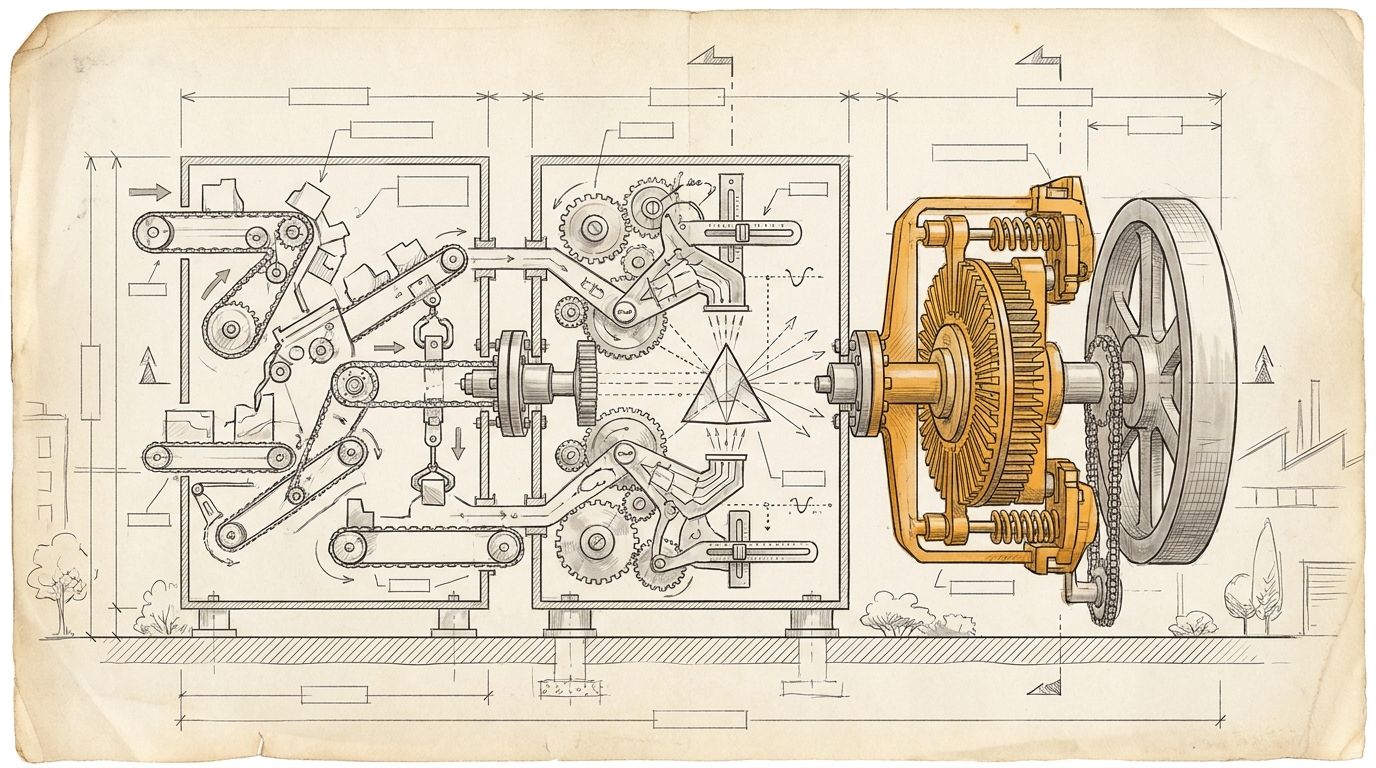
Many reorganisations treat management as one single block. In reality, it contains at least three jobs: coordination, sensemaking, and accountability. AI mostly makes the first one cheaper.
Many organisations are asking a new favourite question: how many management layers do we still need?
It sounds modern. Flatter organisations, less coordination, faster teams, more direct responsibility. Add AI as an accelerator: summaries, status updates, reporting, knowledge search, meeting notes, decision documents. A lot of what used to pass through middle management can now, at least partly, be condensed by systems.
But there is a dangerous error inside that question.
Management is not a homogeneous block. Management is a mixed bundle.
In many roles, at least three jobs are bolted together:
- Coordination: status, handoffs, alignment, reporting, meeting load
- Sensemaking: translating ambiguous signals into decisions
- Accountability: carrying conflict, assessing performance, supporting development, making decisions attributable
AI does not attack these three jobs with the same strength or at the same speed.
It makes coordination cheaper. It can support sensemaking. It does not, hopefully, replace accountability.
And if you do not separate those three things cleanly, you can very quickly build an organisation with less management, but not more leadership.
Stay up to date
Get notified when I publish something new, and unsubscribe at any time.
Routing dies first
The first job is routing.
Information has to move from A to B. One team needs status. Another team needs context. A decision needs supporting material. A leader needs a summary. A customer needs an answer. A project needs meeting notes, a risk update, a roadmap, a prioritisation list.
A lot of middle management was exactly that: human transmission belts between functions, layers, and decision points.
That was not always bad. In a world of scarce information, poor search, and expensive documentation, it was rational. Someone had to know who was working on what, which decision was stuck, which dependency was becoming risky, and which conflict was not yet being said out loud.
But this routing layer is precisely what AI makes thinner.
A system can summarise meetings. It can condense status from tickets, documents, and chats. It can prepare handoffs, collect open points, draft decision papers, and structure recurring communication.
That does not mean it gets everything right. But it makes enough of this work cheaper that organisations will question the old density of management.
The fair point is this: part of middle management really was expensive handoff administration.
If that part disappears, it is not a cultural loss. To be blunt, it is dust removal.
Sensemaking becomes scarcer, not cheaper
The second job is sensemaking.
And this is where many reorganisations start to go wrong.
When less coordination is needed, organisations quickly assume that less leadership is needed too. But sensemaking is not the same thing as routing.
Sensemaking means turning contradictory signals into a direction that people can act on.
The customer says A, the data says B, the team feels C, Legal warns about D, and the strategy seems to imply E. At some point, someone has to say: this is what it means for us now.
AI can help. It can collect patterns, frame alternatives, surface risks, test assumptions, and bring past decisions into view.
But it does not take over the political and organisational translation. It does not know which conflict is bearable, which decision will tilt a culture, which market signal matters, and which one is just noise. It can prepare sensemaking. It cannot carry it. It cannot, to use the current vocabulary, own it.
When companies remove coordinative managers without anchoring the sensemaking function somewhere else, a familiar symptom appears: everyone has information, but nobody knows what it means.
So communication increases. More all-hands. More updates. More alignment formats. More slides.
It looks like a communication problem.
In reality, authorised sensemaking is missing. But please: do not confuse that with dictatorship.
Accountability cannot be automated
The third job is accountability. Responsibility.
This is the unfashionable part. That is exactly why it is easy to overlook.
Someone has to assess performance. Someone has to carry conflict. Someone has to say that one person is growing, another is avoiding the hard part, a team is overloaded, a goal was never serious, or a decision finally has to be made.
That is not merely an information task.
It is social and organisational responsibility.
AI can draft feedback. It can surface patterns in goals, reviews, and work output. It can suggest development plans and structure conversation notes. But it cannot be responsible for the effect of that feedback. It cannot carry the relationship. It cannot credibly decide what is fair, hard, necessary, or cowardly. It cannot replace you as a human being.
In Europe, there is another layer. Responsibility is not only cultural. It is often legal and institutional too: performance assessment, co-determination, data protection, qualification, documentation duties, human oversight. If you replace leadership with tooling here, you do not get a modern operating model. You get a liability and trust problem.
So the hard question is not: can we have fewer managers?
Of course many organisations can have fewer managers.
The hard question is: where does the responsibility go that used to sit inside those roles?
The wrong reading of the flat organisation
US tech currently offers plenty of images of flatter, denser organisations.
Meta talked in the Year of Efficiency about fewer layers and less latency. Shopify uses AI as a filter for new headcount. Block describes smaller teams with better tools and higher leverage.
Those are relevant signals.
But they are often read too crudely.
The right lesson is not: management disappears. The right lesson is: the old package gets unbundled.
Routing is automated or heavily condensed. Sensemaking moves closer to the work. Accountability needs clearer attribution because there are fewer layers to hide behind.
That is harder than simply “getting flatter”.
A flat organisation without sensemaking becomes loud. A flat organisation without accountability becomes political. A flat organisation without routing can work if its systems are good. But a flat organisation without leadership only becomes unclear faster.
This is the point where many reorganisations later walk things back. Not because flat was wrong, but because they failed to distinguish which management function they had actually removed.
The DACH consequence
For German and European companies, copying the US story is especially risky.
First, operational AI maturity is often lower than the management rhetoric. It sounds AI-native, but day-to-day work still depends on email, approval loops, SAP workarounds, Excel logic, and informal experts.
Second, co-determination reaches directly into AI-supported work and leadership processes. That is slow. But it forces clarification: what is being measured? What is being automated? Who sees which data? Where does human oversight remain?
Third, accountability in regulated and more socially embedded organisations is not just a management style. It is part of the operating system.
That is why the winner will not be the company that cuts management most aggressively.
The winner will be the company that decomposes management more cleanly:
- less routing, because systems can carry context better
- more sensemaking where the work is actually understood
- clearer responsibility, because fewer layers remain as hiding places
That is not less leadership. It is less administration around leadership.
The leadership test
Before the next layer reorganisation, three lists should be on the table.
First: which tasks in this management layer are pure routing?
This list can be aggressive. Collecting status, writing summaries, formatting handoffs, preparing standard communication, documenting meeting output. A lot of this can shrink. Honestly, a lot of it should disappear entirely.
Second: which tasks are sensemaking?
Here the list gets thinner. Translating priorities, resolving conflicts between strategy and reality, weighing local signals, making decisions usable for the people doing the work. This work does not disappear just because a dashboard gets better.
Third: which tasks are accountability?
Feedback, conflict, development, performance assessment, fairness, protection from overload, a clear no. If this list does not land anywhere after the reorganisation, you have not modernised. You have evaporated responsibility.
The decisive question is:
Which management work do we actually want to automate, and which do we finally need to take more seriously?
AI makes coordination cheaper. That is good.
But if companies conclude from this that leadership gets cheaper, they are confusing the transmission belt with the motor.
Go deeper
Three follow-up pieces if you want to take the argument further.
Loop Instead of Pipeline
AI is not just speeding up work. It challenges the operating model that knowledge work has been built around.
Evaluation Is the New Leadership Work
Many companies are building AI control. What is often missing is the layer above it, the one that checks whether this steering logic is actually …
Who Builds Your Judgment?
Many companies introduce AI as a productivity lever. In the process, they often automate exactly the layers of work on which later quality and …