The Invisible Economy
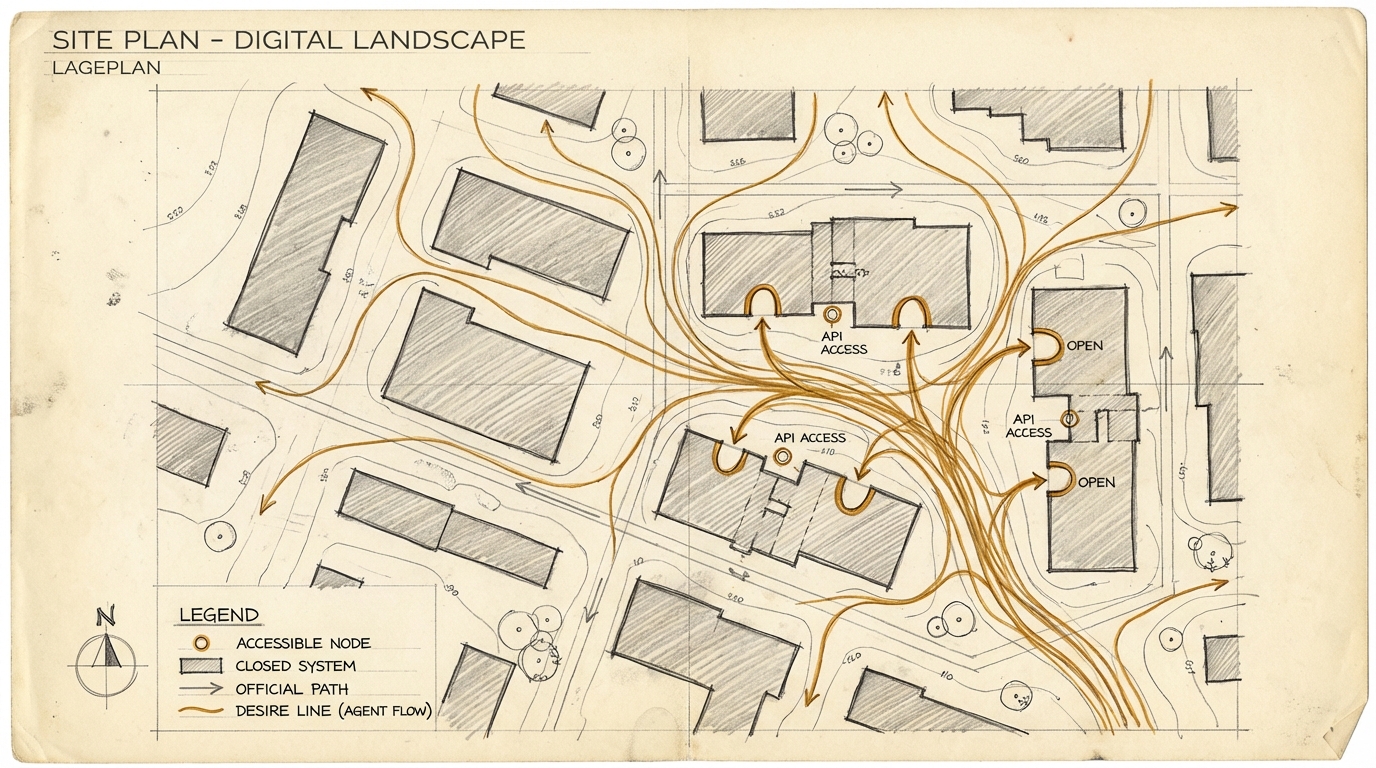
What happens when your products don't exist for agents
Practical test for this essay
Three templates for a conversation with an AI: clarify the goal, check contradictions, test whether the work can be delegated. You do not get a finished strategy or a tool recommendation.
Open the templatesSix companies launched agent commerce infrastructure in a single week. Stripe, Google, OpenAI, Coinbase, Cloudflare, Sabre -- all at the same time. Sounds like coincidence, but it's coordination. And it sounds like the future, but so did the metaverse. The difference: this time the infrastructure plugs into real platforms, not virtual worlds. And the industries that fight back hardest reveal the most about where the real disruption lies.
Stay up to date
Get notified when I publish something new, and unsubscribe at any time.
In mid-February 2026, something happened that didn't make any single headline but was hard to ignore in aggregate.
Coinbase launched a payment protocol where software pays software. Stripe built tokens that let an agent shop at any merchant on behalf of a human. OpenAI added a buy button to ChatGPT for its 900 million weekly users. Google, together with Shopify, Walmart, and Target, introduced a commerce protocol. Cloudflare published a format that lets agents read websites. Sabre went live with APIs that let an agent book flights.
Six companies. One week. And the pattern is more interesting than the individual announcements: they're all building infrastructure for an economy where agents buy things, not humans.
This is either the beginning of a new trade infrastructure. Or the next coordinated announcement that will be as relevant as the metaverse in two years.
The truth is probably somewhere in between.
The thesis: The web is developing an agent layer. If your products and data aren't visible there, you lose a growing share of commerce. But the timeline is murkier than the infrastructure announcements suggest -- and anyone who invests in panic now is making the same mistake as with Voice Search Optimization in 2017.
Why this time might be different -- and why not
Before we talk about industries, readiness, and consequences, an honest assessment.
The parallels to the metaverse hype of 2021-22 are obvious. Back then, there were coordinated infrastructure launches too. Meta built Horizon Worlds, Microsoft bought Activision, Nike opened a virtual store. The argument was the same: the infrastructure is here, the rest will follow. The rest didn't follow.
And Voice Search Optimization was the last "new SEO" that was considered inevitable in 2017. ComScore predicted that by 2020, half of all searches would be voice-based. Today, nobody seriously optimizes for voice search.
Still, there are reasons why this time could be different.
The infrastructure plugs into existing platforms instead of inventing a new one. Shopify has over a million merchants. Stripe processes hundreds of billions of dollars. This isn't "build a new ecosystem." This is "unlock a layer on top of the existing one."
And the use case is different. Shopping is a problem people would gladly delegate. Walking around in the metaverse was an experience nobody missed. An API endpoint is also cheaper than a VR headset.
But there are weighty counterarguments. Coinbase's x402 protocol -- the supposed agent payment infrastructure -- had 78 percent non-organic transactions in February. Volume dropped 90 percent between December and February. Infrastructure exists. The market behind it doesn't. Not yet.
And: agent-delegated purchasing is a rounding error in commerce today. Less than one percent. The question isn't whether that number grows. The question is how fast -- and which industries get hit first.
The used car test
I need a used car. Budget 25,000 euros, station wagon, under 80,000 kilometers, no older than 2020. In an agent world, I'd tell that to an agent and it would handle the rest. In the world we live in, it handles approximately none of it.
Let's start with the basics. mobile.de has no public API. AutoScout24 has no public API. eBay Kleinanzeigen has no public API. Three platforms where the German used car market happens, and none of them let an agent in. Not because the technology doesn't exist. But because information asymmetry is their business model.
But even if an agent had access: what would it do with my preferences? "Budget 25k, station wagon, under 80k km" -- it can process that. "Feels solid" is not a spec. "Not too bulky, but enough room for the dog and two bikes" is not a spec. "No gray, no silver, nothing that looks like a company car" -- maybe that translates to color filters, but the intention behind it is taste, not specification.
Then there's comparability. mobile.de, AutoScout24, eBay Kleinanzeigen -- each platform has different data formats, different fields, different categories. An agent would have to normalize three different data structures without a common standard. Technically solvable. But nobody solves it because the platforms have no interest in it.
And finally, what I've called "terrain" in earlier issues: the knowledge that's not on any map. "The price is good for this equipment level in this region." "This dealer hides accident damage." "For that model year, the timing chain is a problem." That knowledge lives in the heads of people who've been buying used cars for twenty years. Agents operate without terrain.
The used car example shows the pattern: it's not just about APIs. It's about specification, evaluation, and terrain. And the industries that struggle most are the ones whose business model is built on exactly the information asymmetries that agents would dissolve.
Agent readiness is not an IT project
An industry's readiness for agent commerce doesn't depend on whether someone has an API. It depends on whether the industry wants it.
E-Commerce: The infrastructure is there -- for some
E-commerce is furthest along. No surprise. Standardized products, transparent prices, existing infrastructure. ACP and UCP are live. Shopify's million-plus merchants get agent access. McKinsey pegs the market at 3 to 5 trillion dollars by 2030.
But here's what's missing from the press releases: Amazon is a walled garden. The SP-API costs $1,400 per year and strictly limits access. Amazon has no interest in an agent comparing prices across platforms. The world's largest e-commerce player actively blocks agent transparency. Interesting, right?
And I don't need an agent to buy a book or a toothbrush. I can do that in three minutes. Agent commerce gets interesting where comparisons are complex, decisions are expensive, and prices are opaque. Exactly where providers have the least incentive to be transparent.
Travel: Live, but patchy
Sabre has put travel APIs live. An agent can search, compare, and book flights. 400 airlines, 100,000+ hotels. Technically, it works.
Except: Booking.com has no public API and has paused partner registrations. Airbnb blocks agents via robots.txt. Two of the three largest travel platforms say: not with us. And if you think about it for a second, it makes sense. Booking.com makes money by controlling which offer the user sees. An agent that compares all options neutrally is the opposite of their business model.
Automotive: Mercedes versus the rest
Mercedes has a car configurator as an API. The exception that proves the rule. mobile.de? No API. No vehicle data standard. The German automotive market, one of the largest in the world, is a desert for agents.
Not by accident. Anyone who's bought a used car knows the game: "We just got this one in, I'd jump on it fast." That only works if the buyer can't see in real time that the same model is 2,000 euros cheaper three streets over. The entire value chain is built on that information advantage.
Financial services: Regulation as a shield
In December 2025, Insurify -- an AI-powered insurance comparison tool -- triggered a stock crash among insurance brokers. Willis Towers Watson, Aon, LPL Financial -- all dropped. The message: an agent can compare insurance rates without a broker collecting a commission.
But financial services have something other industries don't: regulatory walls. BaFin (Germany's financial regulator). KYC requirements. Advisory documentation. PSD2 APIs exist, but they're designed for human-facing apps, not autonomous agents. The question "may an agent purchase a financial product on behalf of a customer?" is legally unresolved, and it will stay that way for years.
Regulation here doesn't protect the customer. It protects the business model. Every compliance step an agent can't automate is a moat around the existing business model.
B2B: The laggard
I recently looked at the procurement numbers. 94 percent of procurement leaders use generative AI weekly. And yet PDFs and "price on request" dominate B2B sales. BMEcat and ECLASS as data exchange standards exist. In theory.
The gap is maximal: buyers would love to order via agent. Sellers actively prevent it because "price on request" is the last lever they have in the sales conversation. No sales conversation, no upselling, no relationship management, no margin.
The pattern: Those with the most to lose resist the longest
What runs through every industry: The more an industry depends on information asymmetry, the less agent-ready it is. That's not coincidence. That's economics.
E-commerce, where prices are already transparent: agent-ready. Car dealers, whose business model relies on information advantage: blocking. Insurance brokers, whose commission depends on complexity: regulatory shield. B2B sales, where "price on request" is the last bastion of margin: PDF fortress.
Not out of ignorance. Out of rational self-interest.
And here it gets interesting: the companies that block aren't stupid. They see the trend. They know that an agent that can search mobile.de's inventory shifts the power balance in the car trade. That's exactly why there's no API. This isn't a technical decision. It's a strategic one.
What agents can do -- and what they can't
Readers of previous issues know the model: taste, specification, evaluation, terrain. Four capabilities that become bottlenecks when production gets cheap. In agent commerce, we see what happens when agents have to exercise these capabilities themselves.
On taste, there are hard numbers. Polymarket shows how well agents make quality judgments: business and science, 59 to 64 percent. Arts and fashion, 38 to 49 percent. The more it comes down to taste, the worse the agent performs. Whether a dress fits well, whether a hotel has "the right atmosphere," whether a used car feels "solid" -- there's no database for that. And here's the irony: what agents do best -- comparing commodities -- are low-margin products. The high-margin purchases are exactly the ones where taste makes the difference.
On specification, the pattern is familiar. "Cheapest flight to Barcelona on March 3rd" -- instantly processable. "The right used car" -- not. The same capability I described as a bottleneck of knowledge work in the last essay. Just applied to commerce.
Without evaluation, without systematic verification that the agent chose correctly, agent commerce becomes a random number generator with a payment function.
And terrain -- "this dealer hides accident damage," "the reviews are bought" -- experienced humans build that over years. Agents operate without it. That's why they excel at commodity transactions: you don't need terrain for those.
What follows from this -- and where I'm not sure
If an agent layer establishes itself, the effects don't stop at the transaction. I'm thinking them through in three stages. And I'll say where I'm confident and where I'm not.
First: Agents bypass the UI. When an agent books a flight, it doesn't see display ads. It doesn't click on sponsored results. It doesn't scroll past upselling offers. Forrester estimates minus 30 percent for display advertising. The checkout becomes invisible. The agent doesn't need an "optimized purchase funnel." It needs an API endpoint.
But: the "death of advertising" has been predicted at least seven times. DVR, ad blockers, Netflix, GDPR. Advertising has survived every prediction because it adapts. The principle remains: attention is scarce, and whoever has it gets paid. Attention just shifts. Agent-targeting instead of user-targeting. I don't bet against advertising.
Second: Price transparency becomes total. Where agents have access, every price difference becomes visible. That compresses margins. The free-tier web -- content funded by advertising -- collapses where agents don't see the ads. And brand shifts from emotional to algorithmic: not "I trust this brand" but "the agent identified this product as optimal." That's an uncomfortable thought for anyone building brands.
Third: New gatekeepers. Whoever controls the agent layer controls access to the customer. OpenAI, Google, Anthropic become the new gatekeepers, like Google became for web search. "Human-curated" becomes a premium feature.
All of this sounds dramatic. And here I have to be honest: we're far from it. Right on direction, wrong on timing -- that's practically the same as wrong. Anyone who invested in Voice Search Optimization in 2017 might have been right about the direction. Economically, it was as relevant as investing in fax machine SEO.
What LLMs can do on their own -- and why that makes things more complicated
There's a counterargument I don't want to leave out: LLMs can parse unstructured data remarkably well. An agent might not even need an API. It can read the website. It can process PDFs. It can extract relevant data from a free-text listing on eBay Kleinanzeigen.
That's true. And it means that "agent readiness" may be less critical than the infrastructure announcements suggest. The APIs and protocols being launched now make agent commerce more efficient. But a sufficiently capable agent can work without them -- slower, more expensive, more error-prone, but it can.
That shifts the argument. The question isn't binary -- "has an API or doesn't." The question is: how much friction is in the process? And at what friction level does it become worth it for an agent to bother?
For a book on Amazon: zero friction, with or without an API. For a used car on mobile.de: enough friction to make an agent fail -- not because of the technology, but because of the terrain. The listing says "accident-free." Whether that's true isn't in any database. No LLM in the world can parse that, because the information doesn't exist.
What this means for you
Three scenarios, depending on where you stand.
If you sell e-commerce or standardized services: The agent layer is coming. Not tomorrow, but faster than you think. ACP and UCP are live. Shopify merchants are becoming agent-accessible. If you're not visible here, you become invisible -- not to humans, but to the agents shopping on humans' behalf. Investing in structured product data, API access, and agent-compatible checkout flows isn't a bet on the future. It's infrastructure that creates value even without agents -- better data quality, better process efficiency.
And one aspect the US-centric debate overlooks: if your competitors on AliExpress and Temu make their catalogs fully agent-accessible and you don't, that's not a local problem. It's an international competitive gap.
And here, the DACH region has a structural advantage most people overlook: Regulation isn't a brake. It's architecture. GDPR, the AI Act, industry-specific compliance. When you have to explain to a works council or a data protection officer what an agent is and isn't allowed to do, you're building a rulebook in the process. Clear responsibilities, defined boundaries, everything documented. Exactly what agent commerce needs to function. Works councils and data protection officers aren't the blockers in this story. They're the first stakeholders who force the agent layer to be built properly.
If your business model relies on information asymmetry: You have time. But not unlimited time. The regulatory walls, the proprietary data formats, the "price on request" strategies -- they work. For now. The question is whether a competitor leverages the agent layer before you do. In insurance, Insurify showed what happens when someone dissolves the asymmetry. Broker stocks didn't drop because Insurify was better. They dropped because the market understood that the business model of "opacity" has an expiration date.
If you work in B2B sales: The biggest gap. Your customers want to buy via agent. Your sales organization prevents it. That's rational short-term and dangerous long-term. Not because agents will replace B2B sales tomorrow -- they won't. But because the companies that structure their product data, make their prices transparent, and build agent-compatible interfaces will have an advantage in the next RFP process. Not because the buyer sends an agent. But because the buyer, alongside 94 percent of their peers in weekly AI usage, expects product information to be machine-readable.
And something else that gets lost in the "price on request" discussion: not all price opacity is strategic. Some B2B prices are complex because the deals are complex -- volume discounts, service-level agreements, payment terms, logistics conditions. An agent that only sees the list price makes worse decisions than a buyer who understands the deal structure. Agent transparency is not automatically agent competence.
The question behind the question
The convergence is real. The infrastructure is being built. The protocols exist. The question is not whether an agent layer emerges.
The question is whether it becomes relevant before the next hype cycle takes over.
The honest answer: for e-commerce and standardized services -- yes, probably. For used cars on mobile.de -- not in the next three years. For financial products -- not before regulation catches up. For B2B -- not before sales organizations allow it.
And that's the real pattern. It's not a technology problem. It's not an API problem. It's the question of who's willing to allow transparency -- and who has built their business model on preventing it.
The industries built on information asymmetry will resist the longest. Not because they don't understand the technology. But because they understand it too well.
The mobile.de question remains open. My agent still can't find a used car for me. And that's not because the technology doesn't exist. It's because too many people make too much money from the fact that I have to do it myself.
Sources
- Coinbase Agentic Wallets / x402: coinbase.com -- Agentic Wallets, x402 payment protocol; 78% non-organic transactions, 90% volume drop Dec-Feb
- Cloudflare Agents: cloudflare.com -- Markdown for Agents, AI Index
- Stripe Agentic Commerce: stripe.com -- Agentic Commerce Suite, Shared Payment Tokens
- OpenAI Agent Commerce Protocol: openai.com -- "Buy it in ChatGPT", ACP for 900M weekly users
- Google Universal Commerce Protocol: blog.google -- UCP with Shopify, Walmart, Target
- Sabre Agentic Travel APIs: sabre.com -- MCP Server, 400+ airlines, 100,000+ hotels
- McKinsey Agentic Commerce: McKinsey -- $3-5T agentic commerce by 2030
- Amazon SP-API: developer.amazonservices.com -- $1,400/year, restrictive access
- Booking.com partner pause: Partner registrations paused, no public API
- Airbnb robots.txt: Agent-blocking via robots.txt
- Mercedes Car Configurator API: developer.mercedes-benz.com
- Insurify / broker stock crash: December 2025 -- Willis Towers Watson, Aon, LPL Financial
- Forrester display advertising: Forrester -- projects -30% display ad audience through agents
- Polymarket AI predictions: polymarket.com -- 59-64% business/science, 38-49% arts/fashion
- Taste/Spec/Evaluation/Terrain framework: Introduced in dekodiert #2: "Who's Specifying, Anyway?" and issue #1
- Voice Search 2017: ComScore 2017 -- "50% of all searches by 2020 will be voice"
Practical test for this essay
Three templates for a conversation with an AI: clarify the goal, check contradictions, test whether the work can be delegated. You do not get a finished strategy or a tool recommendation.
Open the templates