Co-Determination as Architecture
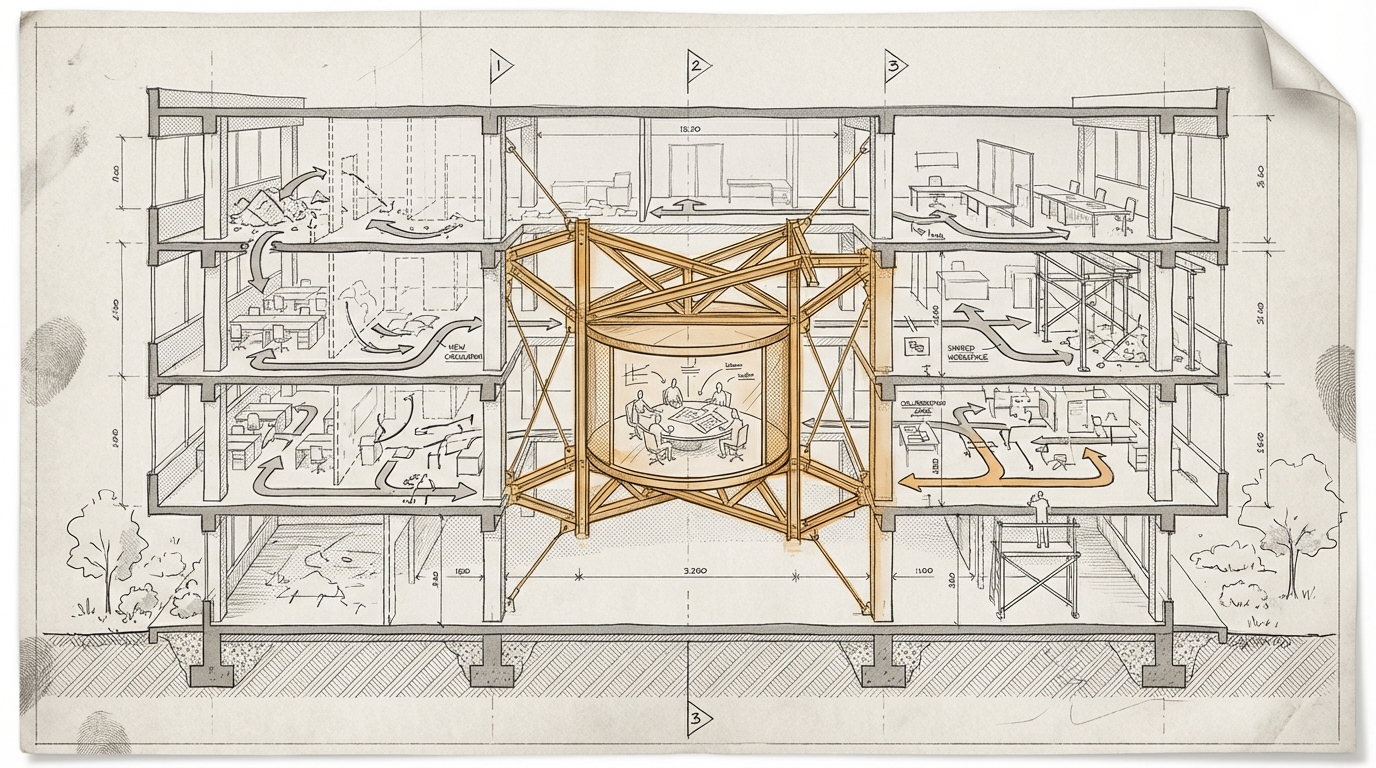
The German path is slower. That may help, because it forces companies to spell out what is actually changing about the work.
Practical test for this essay
Three templates for a conversation with an AI: clarify the goal, check contradictions, test whether the work can be delegated. You do not get a finished strategy or a tool recommendation.
Open the templatesThe most interesting writing on AI transformation is currently coming out of San Francisco, Austin, and New York. The best frameworks too. They talk about loop owners, transposed organizations, dark factories, and agentic teams without handoffs. The problem begins when you lay those models onto a German company with 2,000 employees, a works council, and collective agreements. At that point, what often happens first is: nothing.
Not because the ideas are wrong. But because they usually assume a world in which you can eliminate roles, recut teams, and redesign processes without much negotiation. In Germany, you cannot. Here, you have to ask.
And that may be exactly where the advantage sits.
This essay is not trying to romanticize the German path. It is making a practical point: where many US texts celebrate speed, co-determination forces a better diagnosis of what is actually being redesigned. If that is true, then German slowness is not only a brake. Under certain conditions it becomes a structural advantage.
Practical test: The three templates for this essay help you translate an AI change into language a works council can actually assess, find a viable pilot zone, and avoid marking existing roles as redundant too quickly. You will not get legal advice or a finished works agreement. You will get better questions for redesigning work. Open the templates
Stay up to date
Get notified when I publish something new, and unsubscribe at any time.
The Translation Problem
A large share of Anglo-American AI literature assumes organizational fluidity.
Brian Casel says: hire an owner. Shrivu Shankar says: transposed organization. StrongDM shows a software factory in which three people with agents deliver what used to require a much larger team. All of that assumes that roles and processes can be reconfigured freely.
In an at-will context, that is a realistic assumption. In Germany, it is not.
Here you have dismissal protection. Collective agreements. Co-determination rights over changes to workplaces and processes. Operational changes that are not just organizational, but legally relevant. The naive reading says: this slows transformation down. The less naive reading says: it forces companies to ask better questions.
Because once you have to convince a works council that a process should be cut differently, one question becomes unavoidable:
What does this process actually exist for?
And that is exactly the question many AI initiatives otherwise skip.
Where Co-Determination Actually Hurts
This sounds abstract as long as you only talk about "role redesign." In practice, co-determination shows up in very concrete places.
It appears in the question of how work will be evaluated in the future. In the question of how transparent agent systems must be to employees. In the question of what kind of qualification is needed so that a coordination role can evolve into an ownership role. And in the question of whether a new AI workflow creates relief, or merely intensifies work.
That is where good management separates from bad management.
Bad management treats those questions as annoying side effects of a technical decision that has already been made. Good management recognizes something harder:
These are not side effects. They are the actual redesign.
The Works Council as Institutionalized Process Archaeology
In the electric motor piece, I proposed three diagnostic questions for processes:
- Does this process exist mainly to transfer context between people?
- Does it exist mainly to compensate for human working-memory limits?
- Does it exist mainly to secure trust, judgment, or accountability?
In many American companies, nobody asks those questions before cutting. Or only internally, under pressure to produce visible savings quickly. In Germany, the works council is at least one mechanism that forces precisely this kind of justification.
The works council does not only ask: how many positions disappear? If it takes its role seriously, it asks: what exactly changes about the work? What function did this role actually have up to now? What really disappears, and what is merely being relocated?
That is not a philosophical exercise. It is process archaeology under institutional pressure.
And it matters because the Orgvue numbers are clear by now. More than half of the companies that cut positions because of AI regret it. A third rehired at a higher cost than the savings were worth. The error rarely lies in the technology doing nothing. It lies in analyzing tasks and cutting jobs without understanding the function in between.
In Germany, that gap is harder to ignore, because someone can formally ask about it.
Why That Can Be an Advantage
Co-determination is not an innovation program. It does not generate better ideas. It does not build models. It does not make teams smarter by default. But it does generate something AI transformation urgently needs right now: pressure to articulate.
Phase 3, meaning the reorganization of work around AI rather than the acceleration of existing workflows, demands precision. You have to be able to name:
- which parts of a job are merely coordination infrastructure
- which parts carry judgment and responsibility
- which rules are real constraints
- which rules only exist because of historical limitations
All of that sounds abstract until you look at a typical German redesign. A team currently coordinates seven handoffs between strategy, creation, production, alignment, and approval. With AI, some of that becomes unnecessary. In the American story, that quickly turns into: hire an owner. In Germany, it is more likely to mean:
Which of the people coordinating today could hold end-to-end responsibility tomorrow if the role were recut properly?
That is the decisive translation. Not hire an owner.
Make the existing people owners.
That sentence sounds unspectacular. Organizationally, it is radical. It means the coordinator of today is not simply removed, but developed toward specification, prioritization, and judgment. The loss of coordination work is not booked only as a headcount saving, but understood as newly available capacity for more demanding work.
That is slower than hire-and-fire. But probably more stable.
The Wrong Role of the Works Council
This is where the text has to be careful, otherwise it turns into a feel-good German story.
The works council is not automatically the wise guardian of better transformation. It can be part of the problem just as easily.
If it reads AI only as a threat, co-determination turns into blockage. If management treats it only as an annoying hurdle, co-determination turns into theater. If both sides enter the conversation through the usual reflexes, one with hype and the other with fear, what you get is not architecture. It is bureaucracy.
That is why the relevant distinction is not pro or anti works council. It is:
Is the works council involved as a design partner, or merely as an approval instance at the end?
"Here is our plan, please sign off" is Phase 1 thinking. The basic assumption stays untouched, a new tool just gets bolted on. "Here is what changes in the structure of the work. How do we translate that into our organization together?" That would be the interesting version.
It demands more from both sides.
Management has to explain more clearly what it is actually trying to redesign. The works council has to understand that its contribution does not lie in reflexive rejection, but in distinguishing real protection from the mere preservation of old friction.
The Free Radicals and the Transfer Problem
The German digital industry has known this pattern longer than the current AI discussion suggests. At SinnerSchrader there was once a team called "die freien Radikale," the free radicals. The task was simple and dangerous at the same time: test new technologies on real projects and then transfer working patterns into the wider organization.
When such teams fail, they rarely fail at the experiment. They fail at transfer.
The good version looks like this: a small team tries something, proves in a real case that it works, and then builds bridges into the organization. Processes, tooling, standards, platforms. Not just "look what is possible," but "here is how this becomes something others can work with."
The bad version looks different: a few technically brilliant people roll into a project, clean it up, explain to everyone how things should really be done, and leave again. What remains is frustration. Not because the experiment was bad. But because it was never translated.
That lesson is central for AI transformation. A pilot zone needs a transfer mechanism from day one. Not as an afterthought, but as a core responsibility.
And in Germany, the obvious transfer partner may sit exactly where many people only expect friction: with the works council. Not because it builds the technology. But because it can help carry legitimacy across the wider organization.
The Pilot Zone Instead of the Parallel World
That is why the most practical model for German companies is not the permanent skunk works sitting next to the rest of the organization. It is a pilot zone.
One team. One concrete process. One clearly bounded redesign. From the beginning with works council involvement. From the beginning with a clear question: what changes here? What disappears? What becomes more important? Which capabilities need to be translated into standards, systems, and new roles?
The result of such a pilot zone is not just a functioning process. It is four things at once:
- A proven model for one specific case.
- A language with which the redesign can be explained.
- A rule set or operating agreement that makes repetition possible.
- A set of people who can describe the new role from lived experience.
That is the difference between transformation and folklore. Folklore tells stories about the future. Transformation builds the transitions into it.
Why Germany Might Become Better Exactly Here
The point of this text is not that Germany is somehow superior at the AI future. Reality is too messy for that. Speed remains a real disadvantage. American firms can redesign in weeks what German organizations may need months for.
But speed is not the only metric.
Right now it is becoming more obvious that many fast AI redesigns rest on bad diagnoses. They confuse tasks with jobs, output with value, handoffs with work.
If co-determination forces companies to make those confusions visible, then the disadvantage of slowness can become an advantage of care.
That is not romanticism. Care can also just be a prettier word for standstill. But right now it has economic value because the error rate of premature redesigns is visibly rising.
The German path would then not be: we are more innovative.
It would be: we are forced to explain more precisely what it is we are actually redesigning.
And in Phase 3, that is not a side issue. It is a core capability.
What That Means in Practice
For DACH decision-makers, that leads to four rather practical questions.
First: How do you explain AI internally? Through a cost story, through hype, or through a clean description of how the structure of work is changing?
Second: Which process would you choose as a pilot zone? Not the biggest one, but the one where the redesign can be made visible most clearly.
Third: Who currently coordinates seven handoffs and could hold an end-to-end loop tomorrow? Those people are often closer to the future role than the ones currently shouting loudest for relief.
Fourth: Where does your critical knowledge sit? In heads, in PDFs, or in machine-readable systems? And does the works council even know where your Müllers are?
If clear answers do not emerge, that is not a communication problem. It is a sign that the organization does not yet understand its own redesign.
Honesty Check
Three objections to this text are strong enough that they deserve more than a polite nod.
First: Not every works council wants to shape. Some simply want to preserve what is there. Some lack either the technical understanding or the ambition to become a transformation partner.
Second: Co-determination can produce theater too. A works agreement on paper is still not a durable architecture.
Third: The speed disadvantage is real. It may well be that some American companies have already extended their lead before German care starts paying off.
And still, the core thesis remains.
Precisely because the redesign of knowledge work is not just a tooling story but a structural story, the ability to articulate becomes scarce. And in Germany there is at least one mechanism that forces companies not to skip that ability entirely.
The American version of AI transformation likes to tell a story about freedom. Less friction, fewer roles, fewer handoffs, more speed. If the German version succeeds, it will look different. Slower. More cumbersome. Less elegant.
But perhaps also more durable.
Because in the end, the winning organization will not be the one that said "loop owner" the fastest. It will be the one that could explain precisely why a process existed, what could actually disappear from it, and what form of work would take its place.
In Germany, you have to ask. That usually gets described as a brake.
Maybe it is the architecture.
New issues straight to your inbox? Subscribe to the newsletter
Practical test for this essay
Three templates for a conversation with an AI: clarify the goal, check contradictions, test whether the work can be delegated. You do not get a finished strategy or a tool recommendation.
Open the templatesGo deeper
Three follow-up pieces if you want to take the argument further.
The Electric Motor
The real gain does not come from the new tool. It comes when the transmission belts disappear.
Who Builds Your Judgment?
Many companies introduce AI as a productivity lever. In the process, they often automate exactly the layers of work on which later quality and …
What Do You Actually Want?
Many companies treat AI as a tooling question. Often they cannot even state clearly what they actually want.