AI Is the Second Social Question
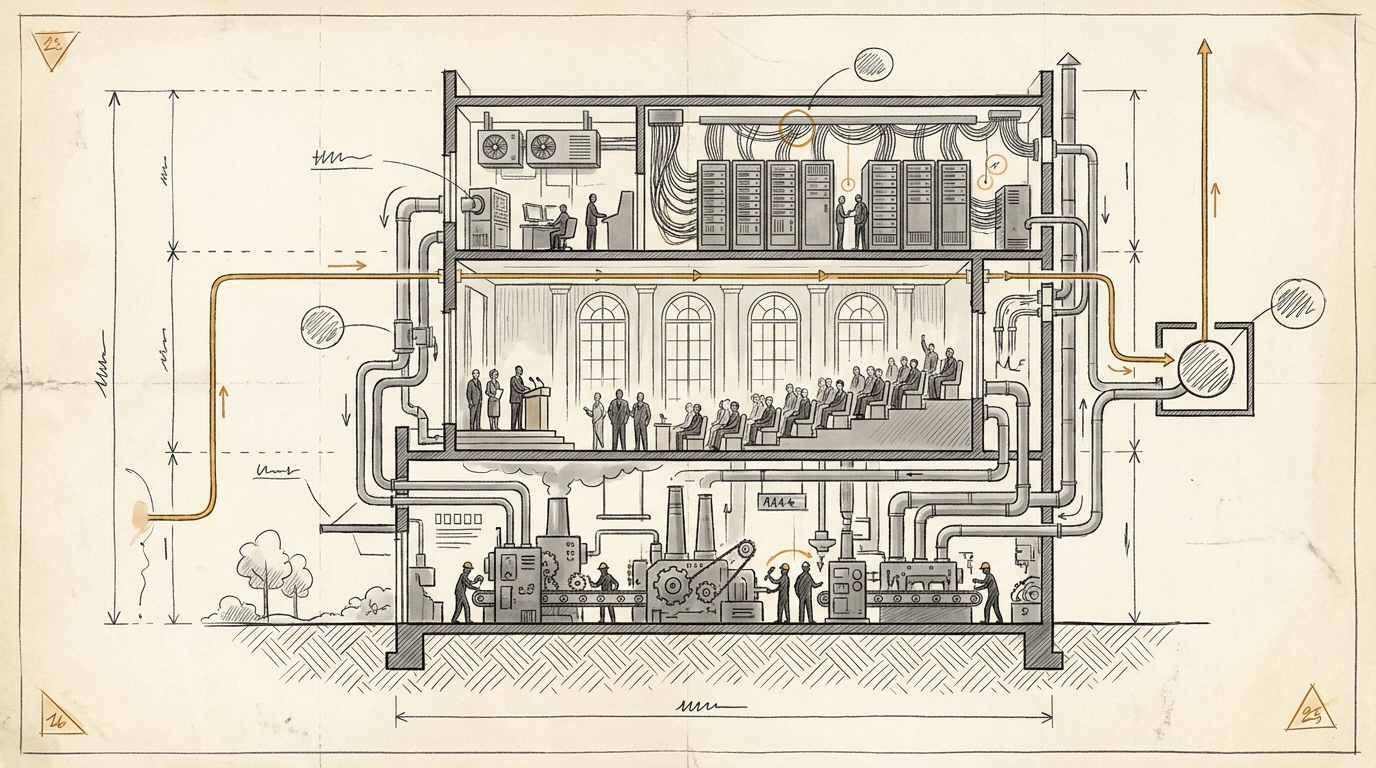
Pope Leo XIV has published Magnifica Humanitas, an encyclical on artificial intelligence. That would be just one more voice in the AI debate if he did not place the issue explicitly in an older line: Leo XIII, Rerum Novarum, 1891, capital and labor. His choice of papal name had already pointed in that direction.
AI is not placed here next to the usual tool questions. It is placed next to the old social question: who gains power, who loses protection, and who carries the consequences?
Leo XIII wrote about the upheavals of industrialization: new power relations between owners, workers, and the state, new dependencies, new classes, new political movements. The first industrial revolution did not merely produce machines. It reordered societies.
In the end, those upheavals were not only social history. They became part of the ground on which the largest wars in human history could grow. Not alone, of course. History is rarely that tidy. But industrial power, mass labor, the nation state, imperialism, class conflict, and technological faith in progress made for a fairly combustible mixture.
That is why the Leo XIII reference is sharper than it may first appear.
The new social question is no longer only wage labor versus capital. It is data, compute, model access, platform power, automation, and the question of who can still object when a decision looks technical.
The encyclical formulates this surprisingly directly. AI is never only a technical matter once it enters processes that decide rights, opportunities, status, and freedom. A system that sorts applications, evaluates credit, allocates benefits, or measures reputation is not a neutral tool. It carries assumptions into the world about what counts, what is ignored, and who is treated as a risk.
That is the strongest point of the text: The question is not only whether AI works correctly. The question is what social logic it stabilizes when it works correctly.
Stay up to date
Get notified when I publish something new, and unsubscribe at any time.
Many companies still talk about AI governance as if it were mainly about error rates, privacy, and approval processes. That is not wrong. It is only too small. Bias sounds like a dataset problem. Hallucination sounds like an output problem. Lack of transparency sounds like a documentation problem.
The encyclical goes one layer deeper. It asks about power.
Whoever owns data, controls infrastructure, can train models, sets standards, and has the money to deploy these systems at scale is not just building software. They are building default reality. What used to appear as law, process, or management decision can now appear as model answer, score, ranking, or automated recommendation.
That does not automatically make decisions worse. But it makes them harder to contest.
A bad manager can be challenged. A bad process can be made visible. A bad rule can be politically debated. A model that produces an apparently objective recommendation from a thousand signals has a different aura. You are no longer objecting to a person. You are objecting to the system.
And systems have an unfair advantage inside organizations: they always look a little more reasonable than people.
The second strong point concerns simulated humanity. Leo XIV writes about the ease of answers, the impression of objectivity, and the imitation of human communication. AI can linguistically reproduce advice, empathy, care, and closeness. That does not mean it possesses these things. But language is often enough for people to attribute more to it than is there.
This is not only a problem for lonely users in chatbots. It is also a management problem. A neatly written AI report can simulate judgment. An automatically generated recommendation can simulate responsibility. An executive summary can simulate understanding. The better the simulation becomes, the easier it is not to miss the absent human judgment.
Here the encyclical touches a nerve companies do not like to touch. AI does not only take work away. It shifts attribution. If a decision goes well, you were innovative. If it goes badly, it was the process, the tool, the vendor, the prompt, the dataset.
That is convenient. And dangerous.
Because the social situation is not more stable than it was in 1891. In many western and northern societies, wealth concentration is growing. The Gini coefficient is not a law of nature, but it shows a direction. Democracy barometers, trust surveys, and polarization studies do not show a cozy landscape either. Institutions are losing binding force while technical and financial power grows in highly concentrated form.
In such a situation, a technology that further scales power is not a neutral upgrade.
You do not need fear of machines to see this. The encyclical does not have it either. It is not anti-technology. It does not say: switch it off. It says, rather: do not confuse technical capability with the right to govern.
That is the core of “disarming AI”. Not banning AI. Taking away the logic of arms race, dominance, and inevitability. That is not the same as compliance. Regulation asks: what may the system do? Disarmament asks: what form of power should it not normalize?
For companies, that is uncomfortable because it shifts the question.
Not: do we have an AI policy?
But: which decisions have we handed to systems without clarifying again who remains politically, professionally, and humanly responsible?
Perhaps that is the real quality of this document. An old institution thinks slowly enough not to mistake speed for progress. That is not always pleasant. But at a time when almost every idea of progress smells of capital requirements, GPU access, and platform strategy, a slow objection is not a bad service.
The first industrial revolution showed that technology does not simply modernize society. It sorts it anew. Sometimes productively. Sometimes brutally.
The second social question therefore does not begin with the question of which model is better. It begins where technical systems sort people, shift responsibility, and concentrate power while companies pretend all of this is merely tool adoption.
Ask yourself or your AI: Which decisions have you already handed to systems without clarifying again who remains politically, professionally, and humanly responsible?