The Quiet Unbundling of Teamwork
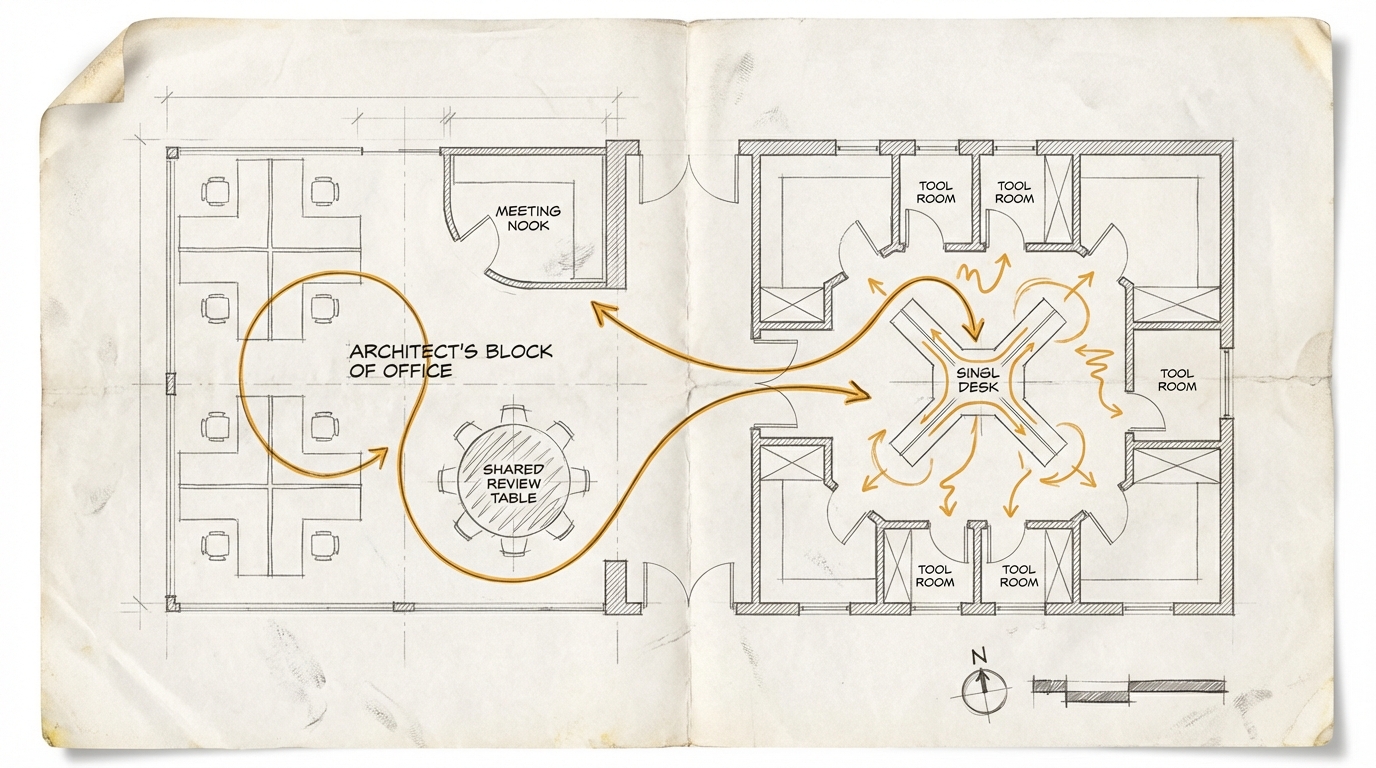
One of the smarter lines in the conversation between Kent Beck and Martin Fowler was not a technological one. It was an organizational one: software work may be getting re-soloed.
That means something very concrete. Fewer people work together on the same problem. Instead, one person works with multiple agents, tools, and threads at the same time. On paper, that looks like leverage. In practice, it is often something else: teamwork gets translated back into individual work with an expanded toolset.
This is not automatically bad. Anyone who has worked with a good agent setup knows the appeal. Less waiting, less coordination, fewer meetings, fewer handoffs. A lot of that is real improvement.
But the shift has a cost. And that cost appears on no productivity slide.
Stay up to date
Get notified when I publish something new, and unsubscribe at any time.
Extreme Programming, pairing, review culture, even good standups never only existed to coordinate work. They were also social guardrails. Places where differences became visible: in language, judgment, pace, doubt. Quality often emerged from exactly that. Not because groups are magically smarter, but because friction makes blind spots visible.
If that same work now shifts into a model of "one person plus six agents," part of that friction disappears. Not the annoying friction. The valuable friction.
That is the subtle point. Many of the new AI workflows look collaborative because multiple instances are working at once. But six subagents are not a team. They do not have conflicting incentives, a different professional socialization, bad mood after a client call, or an instinct for when a suggestion is formally correct but practically stupid. They create variance. But not the same kind of disagreement.
That is why the more interesting organizational question right now is not how many roles AI replaces. It is which form of collaboration gets quietly dismantled in the process.
We talk a lot about acceleration. Less about unbundling. Shared work becomes sequential curation. One person prompts, checks, stitches things together, signs off. That can be efficient. But it can also cause companies to accidentally lose the very social infrastructure that used to absorb complexity.
For me, this is a terrain issue with an organizational edge. As work becomes more scalable through agents, the pressure rises to make teams smaller and more autonomous. That sounds reasonable. Until you notice that this does not only reduce cost. It also removes feedback loops.
So maybe the new ideal team is not "one person with ten agents." Maybe it is closer to this: two humans, one shared judgment, plus the right amount of machine in between. Less romantic. Probably more robust.
Old teamwork was often too slow. The new solo model could become too smooth.
Ask yourself, or ask your AI: Which quality problems in your organization are still being caught by human friction today, and what happens if that friction gets optimized away as inefficiency?