When Flat-Rate AI Turns Into a Meter
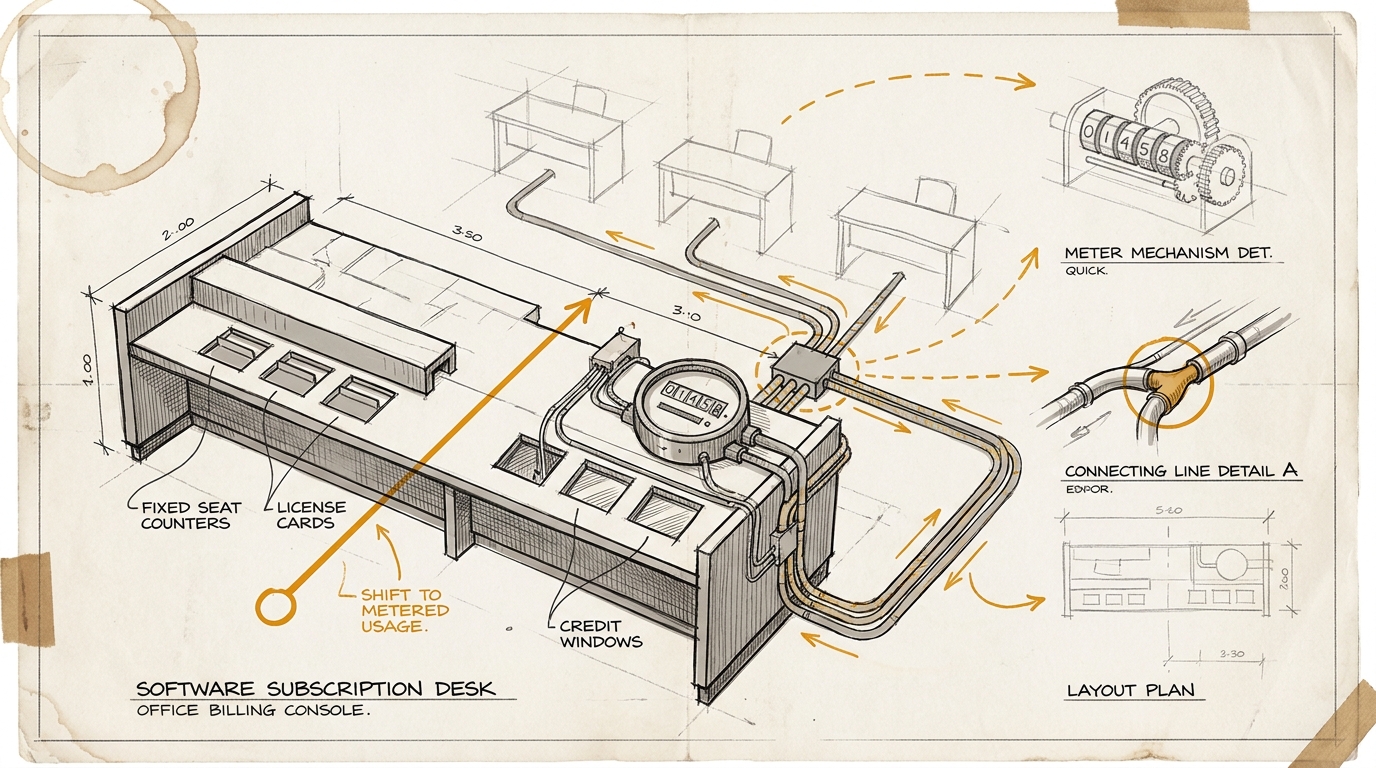
GitHub’s Copilot changes look like a product update at first glance. At second glance they look more like a shift in business logic.
Pro and Pro+ are temporarily unavailable for sign-up. The official pricing page still shows 300 and 1,500 premium requests, plus the option to buy more. At the same time, Ed Zitron surfaced an internal plan to move Copilot customers toward token- and credit-based billing. paddo draws the more interesting conclusion: the feature is not the real change. The billing model is.
For developers, that starts as a pricing story. For companies, it is something larger.
A lot of organizations still budget AI like software: seat license, monthly or annual fee, approval, done. Vendors are increasingly operating the same systems more like usage infrastructure. Not a price per user, but an entry price plus credits, overages, and highly variable cost depending on model choice, context length, and intensity of use.
Stay up to date
Get notified when I publish something new, and unsubscribe at any time.
That is not a minor difference. It is the shift from a flat rate to a meter.
Once that happens, the internal cost-benefit logic changes as well. A tool that looks like a predictable license to procurement starts behaving more like cloud consumption in day-to-day use. Light users stay cheap. Heavy users, long-running agents, and parallel workflows get much more expensive. In other words, exactly the usage pattern many vendors spent the last year aggressively promoting.
Three questions follow for decision-makers.
First: who can still steer this usage in a reliable way? Once cost is tied less to seats and more to depth, duration, and model choice, AI budgeting stops being mostly a procurement issue and becomes a controlling and governance issue.
Second: what does that do to trust? Once vendors shift the economic logic of a product in the middle of active use, the issue is no longer just price sensitivity. It becomes a question of reliability. Companies are not buying function alone. They are buying planning stability.
Third: how uncomfortable does this get once active contracts are involved? From a German perspective especially, this is where the topic starts to move from product news into a more awkward zone. Not in the sense of making quick legal claims. That would require cleaner separation between B2C and B2B, between price changes and service changes, between monthly and annual commitments, and between US and German contract logic. But even without making that leap, the underlying point is clear enough: once a vendor changes the economic metric in the middle of an ongoing relationship, the issue becomes larger than pricing. It becomes a procurement and trust question.
The real lesson is therefore not simply that Copilot may get more expensive.
The real lesson is that many AI vendors are still selling seat licenses while internally operating something much closer to usage infrastructure. And the more agentic the workflow becomes, the less the old license picture matches the real cost structure.
Anyone rolling AI out across a company should therefore look not only at features and models, but also at the pricing logic underneath and at how quickly a vendor might rewrite it under pressure.
Because once flat-rate AI turns into a meter, it is not only the invoice that changes. It is the amount of trust the product deserves as operating infrastructure.
Ask yourself, or ask your AI: Which of your AI tools are still being budgeted like software licenses even though, operationally, you have already bought usage infrastructure?
Sources
- GitHub Copilot: Plans & Pricing (accessed 2026-04-26)
- paddo.dev: Compute Demands: Copilot Joins the Trilogy (2026-04-27)
- Ed Zitron: [Updated] Exclusive: Microsoft Moving All GitHub Copilot Subscribers To Token-Based Billing In June (2026-04-22, linked from homepage)
- German Civil Code, Section 313, Disturbance of the Basis of the Transaction (accessed 2026-04-26)