When AI works faster than your organization can decide
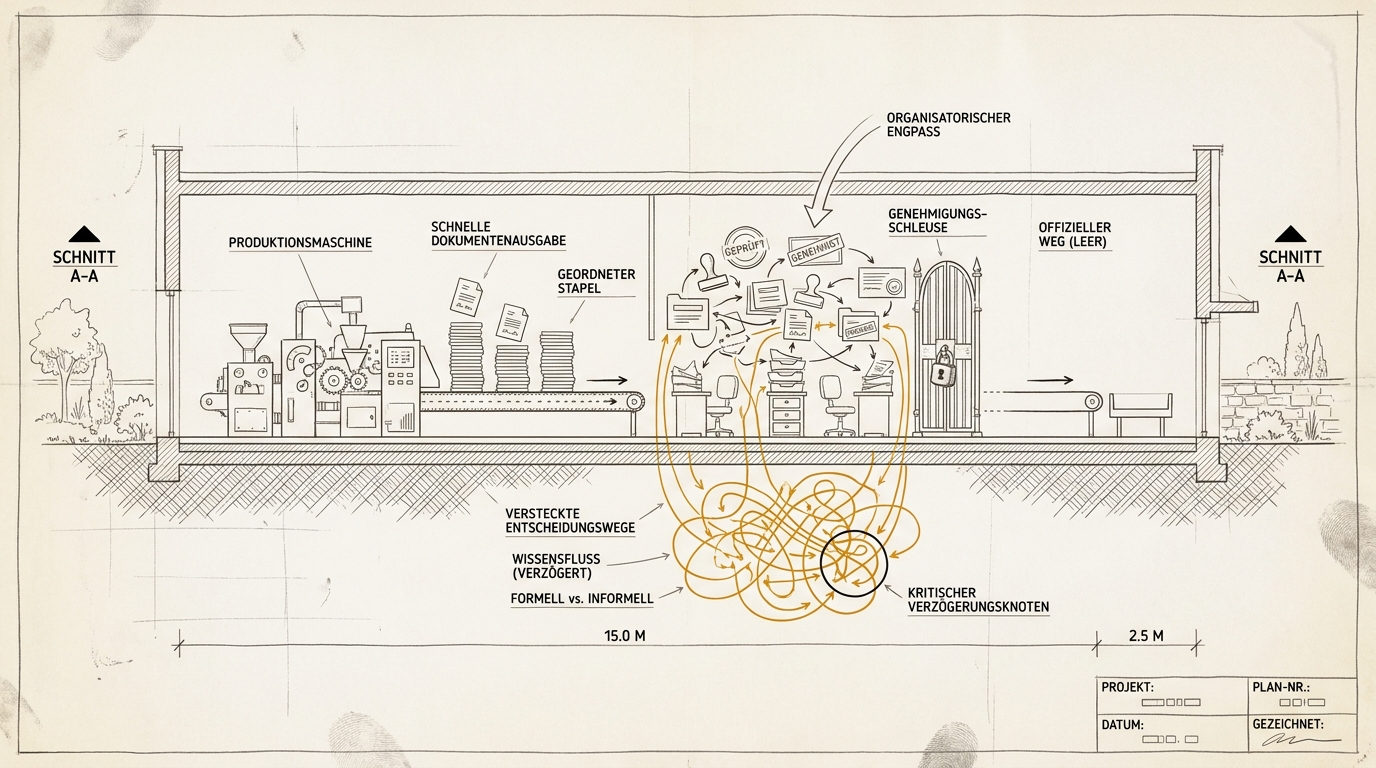
AI shortens the time it takes to produce drafts, reports and variants. It does not automatically shorten the time it takes an organization to decide.
A report that used to take three days is now ready in three minutes.
That sounds like acceleration. Until it sits in review for four days.
This is where the real management question begins. AI does not just make work faster. It exposes where the organization was already slow at deciding.
Stay up to date
Get notified when I publish something new, and unsubscribe at any time.
The bottleneck moves
Many AI projects start with a plausible assumption: if the machine writes, analyses, summarises or drafts faster, the organization will become faster too.
Sometimes that is true. But not automatically.
AI first reduces production time. It does not automatically reduce the time needed for review, approval, coordination, accountability and decision-making.
So the bottleneck does not disappear. It moves.
Before, it often sat in production: who writes the offer? Who summarises the meeting? Who creates the first analysis? Who builds the variants?
Afterwards, it often sits in decision-making: can this response go out? Are the data right? Who checks it? Who is responsible if it is wrong? Who is allowed to decide on this basis?
That is not a detail. It is the difference between output and work.
More drafts do not make a faster organization
A retailer can use AI to generate product descriptions faster. A manufacturer can prepare technical replies faster. A B2B service firm can sketch proposals faster. A bank can write internal briefings faster.
All useful.
But it only becomes acceleration if the AI output can move through the rest of the process.
If every AI draft enters the same old approval loop afterwards, you do not get a more productive organization. You get a faster motorway ramp into the same traffic jam.
The dashboards can still look good. More generated text. More automated tasks. More tool usage. More activity. And in the end, this becomes one of the 95 percent of AI use cases that, according to current analyses, deliver no business value. That is not caused by the quality of the AI.
Activity is not throughput.
Not every approval is dead weight
The bad response would be to treat every approval as old bureaucracy.
That is convenient. It is also wrong.
Some approvals protect customers, prices, data, quality, brand or liability. In Europe, this is not just a nostalgic administrative instinct. It is often operational common sense. "Move fast and break things" is, fortunately, not part of our entrepreneurial DNA at this point. The EU AI Act talks about risk, traceability, documentation and human oversight for a reason. In regulated or customer-facing processes, not every brake is a bug.
So the better question is not:
How do we get rid of approvals?
The better question is:
Which decisions can we make upfront so that every AI output does not have to be renegotiated one by one?
That is the difference between grafting AI onto existing processes and rethinking the existing process under the premise of what AI actually enables. The latter is a little slower at first. In the long run, it creates more value.
The management test
When AI gets faster in your company, do not only test the model. Test decision latency.
Five questions are enough to start:
- Which outputs does AI now produce faster than before?
- Which of them still get stuck afterwards?
- Who is allowed to approve these outputs?
- Which approvals protect real risks, and which only hide unclear ownership?
- Which decisions can be defined upfront instead of renegotiated for every result?
The answers often tell you more about the organization than about the technology.
If nobody owns the decision, that is not an AI problem. If legal needs to review every customer email one by one, maybe a risk class is missing. If the business team debates every result from scratch, maybe the quality standard is missing. If nobody knows which data a tool may see, prompt training is not the missing piece. An operating decision is.
The short version
The next phase of AI adoption will not fail because machines cannot produce drafts.
It will fail because companies cannot decide quickly enough which drafts are allowed to become work.
That is uncomfortable. It is also useful.
AI does not only show what can be automated. It also shows where responsibility is unclear, approvals are historical, data rights are vague and decisions are too slow.
Treat that as a diagnosis of the organization.
Dry stuff. Useful stuff.
Go deeper
Three follow-up pieces if you want to take the argument further.
Executive Briefing: More Output Is Not Productivity
AI can create in minutes what used to take teams hours. But someone still has to review it, make the call, and maintain the whole thing later. That …
Loop Instead of Pipeline
AI is not just speeding up work. It challenges the operating model that knowledge work has been built around.
Executive Briefing: The Missing Audit
Many companies measure AI usage, saved hours, and adoption. What is often missing is the layer that checks whether those numbers represent value at …