Executive Briefing: Design and UX Just Had Their ChatGPT Moment
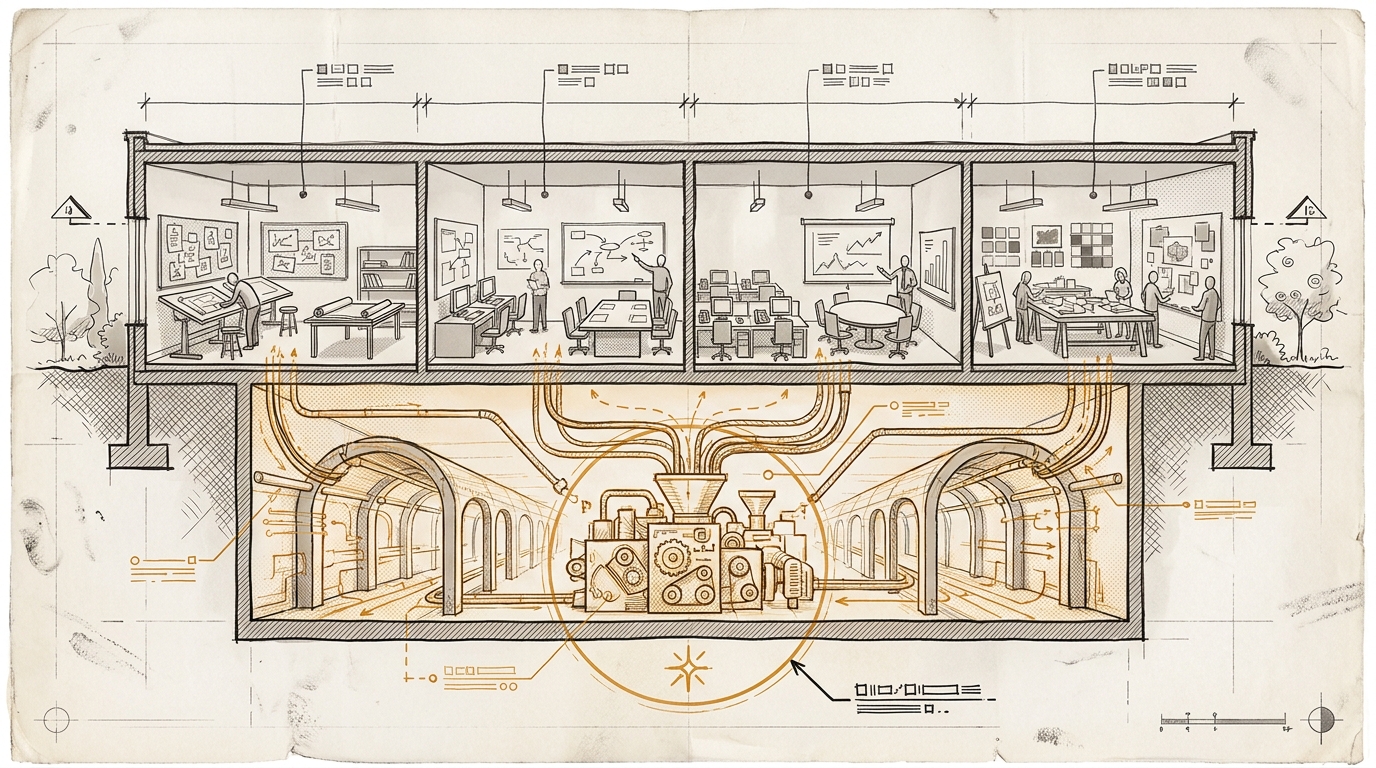
Why Claude Design is strategically more important than its current quality level
Claude Design is not yet good enough to replace Figma.
That is exactly why it is strategically interesting.
The first reactions sound familiar: too templated, too average, only useful for non-professionals, fine for early drafts, but not for real product work.
Stay up to date
Get notified when I publish something new, and unsubscribe at any time.
All of that may be right in detail and still wrong in strategic terms.
I think design and UX just had their ChatGPT moment. And most people are still arguing on the wrong level.
Why this briefing is off-cycle
dekodiert normally appears on its regular schedule. This briefing sits in between because what became visible here is not just a new tool launch, but a new adoption pattern.
On April 17, 2026, Anthropic launched Claude Design. The usual debate showed up immediately: Figma killer or not? Impressive demo or just AI slop? Nice for decks, but irrelevant for real UX?
That is the wrong debate.
The right question is this: what happens when first-pass visual production suddenly becomes as cheap, fast and conversational as text production after ChatGPT and code production after Copilot?
Not perfect. Not autonomous. But good enough to shift routines.
And that is exactly the point where decision-makers should start paying attention.
What actually happened on April 17
Anthropic did not just launch an image generator under a new name. Claude Design is a dedicated interface for visual work. The system can read code repositories and design files, derive a design system from them, generate first artifacts, refine them, and export them to Canva, PDF, PPTX or HTML. Once the direction is clear, the result can be handed directly to Claude Code.
The important part is not the demo itself. The important part is the loop:
Idea → Prototype → Review → Handoff → Code.
This is not an isolated creative toy. It closes a workflow inside a product family many teams are already using for text, research and coding.
Anthropic is not targeting designers alone. The launch post explicitly includes founders, product managers, marketers and account executives alongside design teams. TechCrunch describes the product accordingly as a tool for people without design backgrounds who want to get from an idea to something visual more quickly.
If you read this only as an attack on Figma, you are underestimating the shift. The bigger change is not about which tool wins. It is about who will soon be able to produce a usable first visual state without a design team.
The market read this as a signal. Figma fell by around seven percent on launch day. That proves nothing. But it does suggest that this was seen as more than a side feature.
Why almost everyone is looking at the wrong thing
The sharpest criticism of Claude Design comes from exactly the perspective that most easily hides its significance.
Experienced designers see a tool that still has no clean answer to research, judgment, systems thinking, multi-stakeholder critique, accessibility, information architecture, or the final twenty percent of quality. Akis Apostoliadis aptly called it a “frighteningly competent junior.” Others call it slop, a PM tool, or design for people who never should have been designing in the first place.
All of that may be true and still miss the strategic point.
Because Claude Design does not need to beat the best product designers today. It only needs to beat something much more ordinary:
- the blank slide
- the unwritten one-pager brief
- the pitch-deck draft that never gets made
- the internal tool that never gets a decent UX
- the PM who waits three weeks for design slots
- the founder who walks into every meeting without a visual language
The relevant comparison is not “better than an excellent staff product designer.”
The relevant comparison is: much better than no artifact at all and fast enough to become a new default.
That is how ChatGPT was misread at the beginning. Not as a machine that beats the best analyst, but as a writing interface that could suddenly generate a first usable draft for millions of people.
And Copilot did not become important because it was better at architecture than senior engineers. It became important because it lowered the cost of routine work, boilerplate, variation and flow interruption, and in doing so changed the way people worked.
Claude Design is now at exactly that point for visual work.
You already know the pattern
The early counterarguments are structurally identical.
With ChatGPT, people said: plausible-sounding nonsense, decent language, shallow substance, no replacement for real expertise.
With Copilot, people said: nice for boilerplate, dangerous without review, nothing for serious architecture.
With Claude Design, people now say: nice for first mockups, good for decks but not for real UX, too templated.
If you only focus on whether these objections are correct, you miss the pattern.
The better question is this: what kind of work is becoming cheap enough to lose its previous place in the organization?
With ChatGPT, it was the first text draft. With Copilot, a large part of first-pass code production. With Claude Design, it is now the first visual state.
Not research. Not taste. Not final product quality.
But the first visible, discussable, handoff-ready draft.
And that is exactly the level where workflows start to tip.
Why this time will move faster
I do not think design will move at the same speed as text or code. I think it will move faster.
Four reasons are enough.
First: the model layer is further along. Claude Design is not starting at the level of earlier AI design demos. It starts with stronger vision, higher tool maturity and a more specialized surface.
Second: organizations already have AI muscle memory. In 2023, teams first had to learn how to work with generative systems at all. In 2026, that baseline knowledge is already there.
Third: the material already exists. Many companies now have design systems, component libraries, tokens and brand guidelines. The model does not start from zero. It starts from your existing system.
Fourth: handoff is no longer a foreign body. The path from visual draft to implemented artifact used to be full of breaks. Claude Design is also interesting because it connects to Claude Code. The friction between design and implementation gets smaller.
Taken together, that shortens the learning curve.
The actual shift
If you want to read this signal correctly, do not look at the prettiest demos. Look at the new bottlenecks.
1. The first visual draft becomes cheap
That does not mean good design becomes cheap.
It means the threshold for turning ideas, copy and rough intent into a visible artifact drops sharply. That changes meetings, prioritization and initiatives long before it changes top-tier design quality.
2. The design system becomes strategic infrastructure
If models can read your system from code and design files, the value of clean tokens, components, naming logic and guidelines rises.
At that point, the design system is no longer just documentation for humans. It becomes operating material for machines.
3. The role of design moves upward
When first-pass production gets cheaper, value shifts:
- away from pixel production alone
- toward research
- toward taste and judgment
- toward critique
- toward system maintenance
- toward prioritization and decision readiness
This is the same shift we are seeing in coding: less value in generating raw material, more value in evaluation, direction and responsibility. Jenny Wen describes the same role shift for design very clearly.
4. Visual work outside the design team grows
A large part of the organization already produces visual artifacts anyway:
- PMs with one-pagers
- sales with decks
- marketing with landing pages
- founders with pitch material
- product teams with internal tools
That work was often mediocre, slow or dependent on scarce design bandwidth. Claude Design goes directly after that surface area.
5. The default changes
The most important management question is therefore not:
"Will our design team be replaced?"
But:
“What will our organization start doing with AI by default next quarter before anyone writes a ticket or involves a design team?”
That is the operational shift.
What decision-makers would get wrong now
First: dismissing this as a toy because senior designers still have strong counterarguments today.
Those counterarguments existed in the early phase almost every time. What matters is not whether they are true today. What matters is whether you incorrectly derive strategic irrelevance from them.
Second: reading this only as a tool question.
Figma or Claude is the surface-level debate. The deeper debate is this: where will the first usable visual state be produced in the future, and who controls the loop through to implementation?
Third: blindly optimizing the design team for generation.
That would be the same wrong reaction we saw in coding: more output, less judgment. Teams that react this way will produce artifacts faster, but also produce mediocrity faster.
Fourth: underestimating your own design system work.
Once AI gains access to your visual stack, poorly maintained design infrastructure becomes a bottleneck. Not just for humans, but for machines.
What you should do now
Do not rebuild everything. But take four things seriously right away.
1. Pick two or three safe use cases.
Not the core product, not the most sensitive UX, not the brand relaunch. Instead: internal tool prototypes, pitch decks, landing pages, workshop artifacts or stakeholder one-pagers. That is where you will quickly see whether cycle time, alignment quality and handoff improve.
2. Treat your design system like infrastructure.
If Claude Design learns from your repository and your design files, the quality of those inputs becomes direct leverage.
3. Define new quality gates.
The question is not whether AI will create visuals. It will. The question is who evaluates what is usable, on brand, accessible and product logic rather than mere optics. If that gatekeeper process is missing, you are not scaling design. You are only scaling variance.
4. Measure workflow gain instead of tool parity.
The wrong question is: can Claude Design already do everything Figma can do? The right one is: which loops are now five times faster than they were a week ago?
Five questions for your next management round
If this briefing lands on the table, it should not land there as a thought experiment. It should land there as a conversation starter.
1. Where in our organization are visual artifacts currently created too late, too expensively, or not at all?
2. Which of those artifacts matter enough to test with Claude Design or a similar tool in the next 30 days?
3. Is our design system clean enough for a model to derive consistent work from it?
4. Who will decide what counts as usable and where human judgment remains mandatory?
5. Do we want to shape this shift deliberately, or only react once PMs, marketing and founders have already built their own workflows?
Honesty check
Four points where this analysis could be overstating the case.
First: Claude Design could stall in research preview. If quality, controllability and cost do not improve quickly enough, it may remain a niche tool.
Second: Figma is not disappearing. For complex product work, team collaboration and finer-grained design control, a classic tool will remain relevant for the foreseeable future.
Third: design is not the same as UX. A beautiful artifact replaces neither user research nor interaction logic nor business understanding.
Fourth: the first wave may hit adjacent work harder than the core product. Decks, one-pagers, marketing assets and early prototypes will likely tip faster than highly critical product surfaces.
Even so, the core thesis stands for me:
The early rejection is not the counterargument. It is the pattern.
Framing
Claude Design is not yet a replacement for good designers.
It is something more strategic:
an early signal that first-pass visual production is no longer going to remain scarce.
The analogy to ChatGPT and Copilot is not: "designers are now being replaced."
The analogy is: "a part of the work that used to be expensive, slow and constrained by capacity is now being translated into a new default."
Anyone who saw ChatGPT in 2023 and only said “sounds fine, but not a real analyst” recognized the pattern too late.
Anyone who saw Copilot in 2024 and only said “nice for boilerplate,” too.
Anyone who sees Claude Design in 2026 and only says “this is not enough for real UX” is making the same mistake for the third time.
Sources
- Anthropic: Introducing Claude Design by Anthropic Labs
- TechCrunch: Anthropic launches Claude Design, a new product for creating quick visuals
- paddo.dev: Claude Designed My Blog. Then Claude Built It.
- Drew Bent on LinkedIn: Claude Design and the acceleration pattern also seen in Claude Code
- Akis Apostoliadis: Yes, but is it a “Figma killer”?
- Sam Henri Gold: Thoughts and Feelings around Claude Design
- Lenny's Newsletter: The design process is dead. Here’s what’s replacing it. | Jenny Wen
- Agentic Brew: Anthropic launches Claude Design